
Amsterdam's canals
Over 100 kilometres of waterways, around 90 islands and more than 1,500 bridges — plus a 17th-century city plan that still works today.
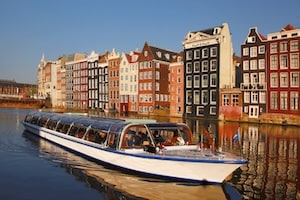
© Yasonya / Shutterstock.com
How many canals does Amsterdam have?
Amsterdam has more than 100 kilometres of canals running through some 90 islands and spanned by over 1,500 bridges. The exact number depends on how you define a “gracht”; the best known and largest are the four main canals: Prinsengracht, Keizersgracht, Herengracht and Singel.
These four form the canal ring around the city centre, which UNESCO declared a World Heritage Site in 2010. Beyond them, countless smaller canals run through the other districts — and it is precisely these narrow waterways that only the small boats can enter.
Why were the canals built?
The canal ring is not a tangle that grew by itself but a city plan. It was laid out in the 17th century, the Dutch Golden Age, and served several purposes at once:
- Trade and transport. Amsterdam was one of Europe's most important trading centres. Goods came along the canals right up to the warehouse doors — which is why many canal houses still have a beam with a hook under the gable.
- Urban planning. The population was growing fast, and the ring-shaped canals were part of a carefully considered expansion plan that ordered the city's growth — functional and aesthetic at the same time.
- Water management. Large parts of the Netherlands lie below sea level. The canals regulate the water level and protect against flooding. They still do that job today.
- Defence. In the city's early history the waterways also served as a line of defence.
That combination explains why the canal ring looks so regular: it was designed on the drawing board and built to plan over decades.
What you see from the boat
A cruise practically always covers part of the canal ring and usually a stretch of the Amstel and the harbour. Along the way are the narrow merchants' houses with their gables, the houseboats, the Magere Brug (Skinny Bridge) and — depending on the route — the Anne Frank House, the maritime museum and the Rijksmuseum.
From the water you see the city from the angle it was built for. That is the real reason a canal cruise is worth it: not the sights you can also reach on foot, but the point of view.
Still undecided?
Most visitors are well served by the classic one-hour cruise — it is the cheapest and runs most often. If you want a bit more, take a small open boat with a live guide.
Compare all canal cruises